
Guye Adola won the men’s 2026 Berlin Marathon in 2:02:50, while Tigst Assefa won the women’s race in a 2:11:04 course record. The race took place on 27 September 2026; this page was updated after the event, replacing the earlier race-week checklist with verified results and pace analysis.
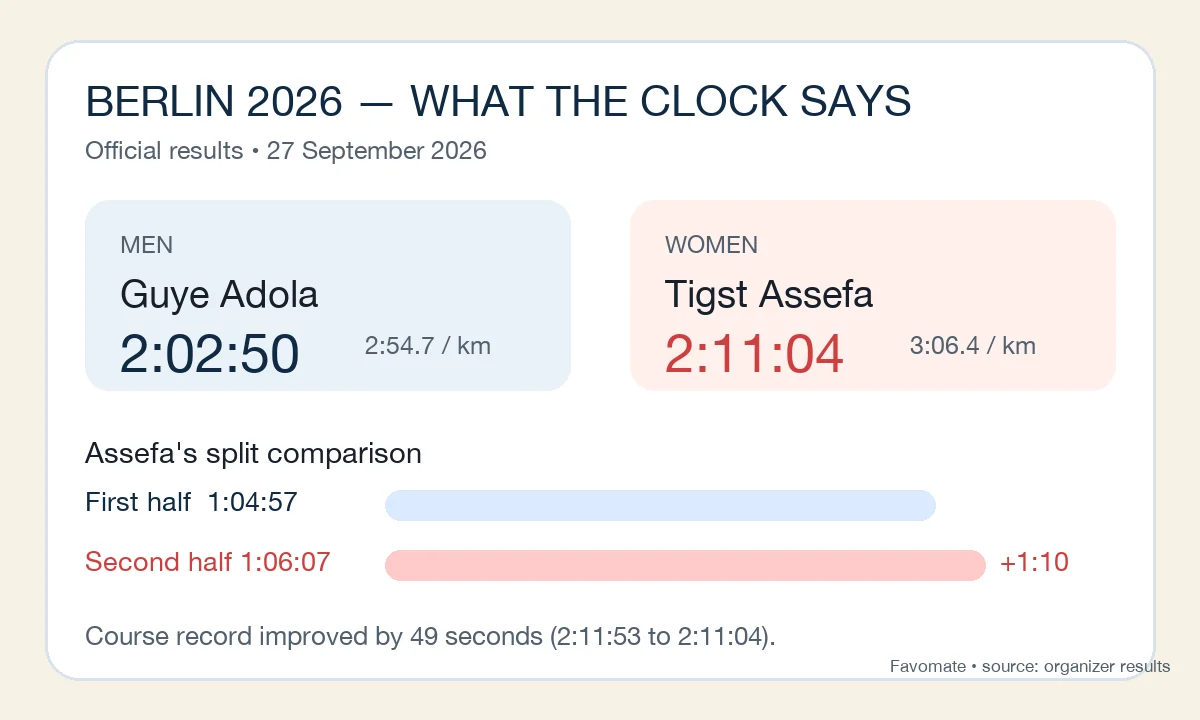
Berlin Marathon 2026 results at a glance
| Race | Winner | Finish | Calculated average |
|---|---|---|---|
| Men | Guye Adola (ETH) | 2:02:50 | 2:54.7/km (4:41.1/mile) |
| Women | Tigst Assefa (ETH) | 2:11:04 | 3:06.4/km (4:59.9/mile) |
The organizer’s official results summary and World Athletics results both record Adola’s winning time as 2:02:50. Adola finished 29 seconds ahead of second place and won Berlin for the second time after his 2021 victory. The organizer lists the combined winning times as 4:13:54, the second-fastest men’s-plus-women’s winning total it has recorded, behind Chicago 2024.
How fast was 2:02:50?
Dividing 2:02:50 by the official 42.195 km distance gives an average of 2 minutes 54.7 seconds per kilometre. That is equivalent to about 14:33 per 5 km or 4:41.1 per mile. These are calculated averages: they do not mean Adola ran every section at exactly that speed.
The men’s margin was narrow by elite-marathon standards. Second place was 2:03:19 and third was 2:03:59, so the podium was separated by 69 seconds. The useful reading is not that a recreational runner should copy the pace, but that even a very fast Berlin course still produced a competitive race rather than a solo time trial.
Assefa improved the course record by 49 seconds
Assefa’s 2:11:04 lowered her own Berlin course record of 2:11:53 from 2023 by 49 seconds. The organizer’s race report gives her intermediate times as 30:48 at 10 km, 1:04:57 at halfway and 1:32:19 at 30 km. It also reports that she was on approximately 2:09:36 pace with 5 km remaining before developing a right-leg problem around 40 km. The exact medical diagnosis should not be inferred from race footage or splits.
Her second half can be calculated directly: 2:11:04 minus 1:04:57 equals 1:06:07. That is a positive split of 1 minute 10 seconds. The number does not show where every second was lost, but it explains why a course record and a missed world record can both be true in the same performance.
Three lessons for reading marathon results
- Separate official facts from calculations. Finish times and recorded splits come from the organizer or governing body. Average pace, margins and half-to-half differences are calculations from those facts.
- Do not diagnose an athlete from a late-race slowdown. Heat, fuel, tactics, muscle damage and injury can produce similar timing patterns. Here, the organizer reported a leg problem; it did not publish a diagnosis in the initial race report.
- Compare like with like. A course record belongs to one event. A world record applies across record-eligible courses. Assefa’s Berlin record was 2:11:04, while the world-record reference in the organizer’s report was 2:09:56.
What recreational runners can use
For your own result, record the official finish, halfway split and any reliable 5 km splits before deciding why the race changed. A first-half/second-half comparison is more useful than judging the final time alone. If your second half slowed, match the timing against weather, perceived effort, carbohydrate intake and symptoms rather than assuming a single cause.
For practical preparation, Favomate’s carbohydrate-loading calculation guide explains what 10–12 g/kg over 36–48 hours means, while the destination-marathon jet-lag worksheet separates eastward and westward travel.
Sources and update note
- BMW Berlin Marathon official 2026 results summary
- Organizer race report, published 27 September 2026
- World Athletics competition results, 27 September 2026
Updated 30 September 2026. The earlier pre-race logistics article at this URL was converted to a post-race results analysis so readers do not land on expired instructions.


コメント