A marathon warm-up is not a test of fitness. Its job is to get you organised for the conditions and the wait you actually face—without spending energy or accumulating heat before 42.195 km. For many recreational runners, a short, familiar, low-stress routine is more defensible than copying a track athlete’s elaborate pre-race sequence.

The useful question is “what problem am I solving?”
There is no research-backed universal number of minutes for a marathon start line. A broad systematic review found that warm-up improved performance in most outcomes examined, but it included many activities rather than marathon-specific trials and called for more well-conducted randomised trials. A runner therefore should not turn that result into a mandatory 30- or 40-minute routine. Read the evidence as a reason to arrive prepared, then match the dose to the event.
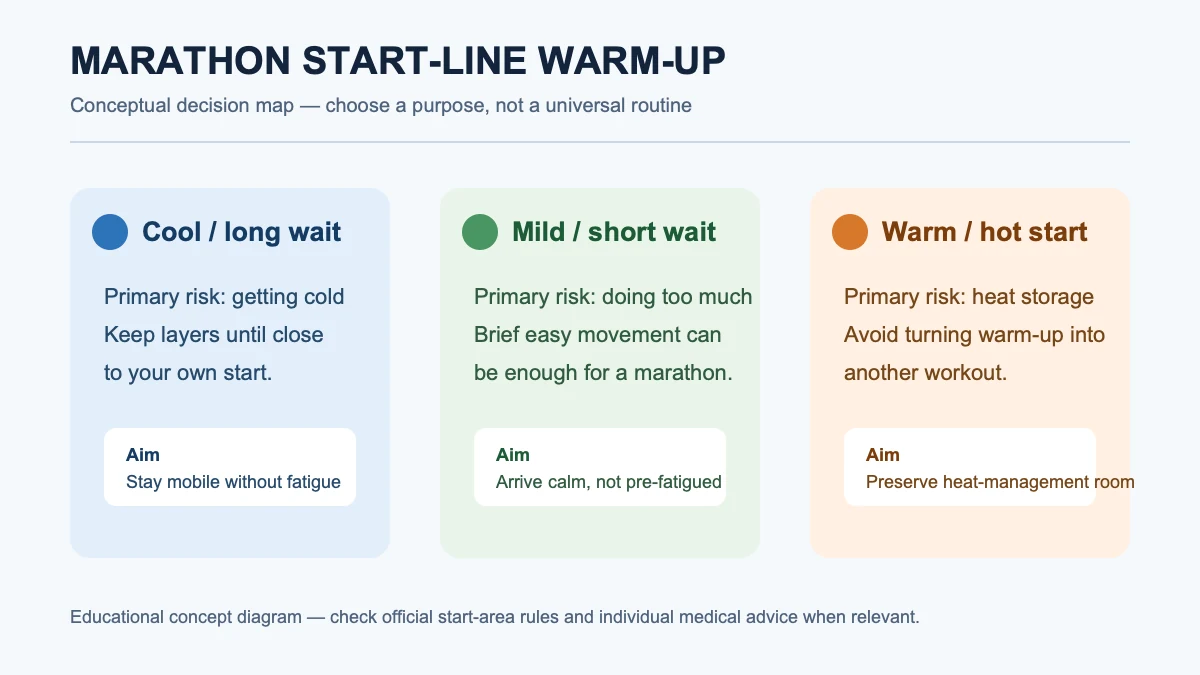
Three situations lead to different priorities:
- Cool weather or a long corral wait: the practical risk is becoming cold and stiff again after doing too much too early. Keep permitted outer layers until close to your own start, and favour small, easy movements over a workout.
- Mild weather and a short, predictable wait: a brief familiar jog and a few dynamic movements may help you feel ready. The finish line is still hours away, so “more activated” is not automatically better.
- Warm or hot conditions: heat storage is the constraint. World Athletics notes that a rise in core temperature can raise cardiovascular strain and perceived effort in endurance events. In that setting, a long hard warm-up can work against the race plan.
Why “priming” is not a reason for hard drills
Post-activation performance enhancement (PAPE) is often used to justify heavy lifts, jumps or sprints before racing. But a 2024 systematic review and meta-analysis of 35 studies (57 comparisons; 432 participants) found very low-certainty evidence and no support for recommending PAPE strategies to improve endurance performance. The apparent pooled benefit was very small and depended on two exceptional results. That does not make a few familiar strides forbidden; it does mean they should not be sold as a reliable endurance performance hack.
For a marathon, use only movements you have rehearsed in training. If a drill raises anxiety, causes a niggle, makes you sweat heavily or leaves you breathing hard, it is a poor candidate for the start area. Dynamic mobility can be a comfortable transition into running, while prolonged static stretching is not a substitute for a race plan; a running-athlete review found no running-economy benefit from static stretching and stressed the limited, heterogeneous evidence base.
A low-drama start-line checklist
- Read the race instructions first. Confirm corral opening, bag-drop and clothing-discard rules. A routine that requires extra space or access you do not have is not a routine.
- Rehearse the smallest version on an easy-run day. The aim is familiarity, not a new stimulus in race week.
- Use the wait as information. If you are standing for longer than expected, preserve warmth and calm rather than repeatedly restarting your warm-up.
- Keep fuel and fluids separate from “warm-up magic.” Follow the plan you practised. For a race lasting hours, a warm-up cannot replace a carbohydrate and hydration strategy.
- Start conservatively. The first kilometres are part of the pacing plan, not an extension of the warm-up.
When to get individual advice
Seek personalised guidance rather than experimenting at a crowded start if you have chest pain, unexplained fainting, heat illness history, a condition affected by temperature or a new injury. In hot conditions, race medical advice and the organiser’s heat plan override generic guidance.
A good marathon warm-up leaves no memorable story: you reached the line warm enough, calm enough and with the energy for the race itself.
Sources and further reading
- Fradkin, Zazryn & Smoliga (2010), systematic review and meta-analysis of warm-up studies
- Pérez-Gómez et al. (2024), PAPE and endurance exercise systematic review/meta-analysis
- Ullman, Fernandez & Klein (2021), warm-up regimens in running-sport athletes
- World Athletics, Warm-up Essentials and Beat the Heat guidance


コメント