
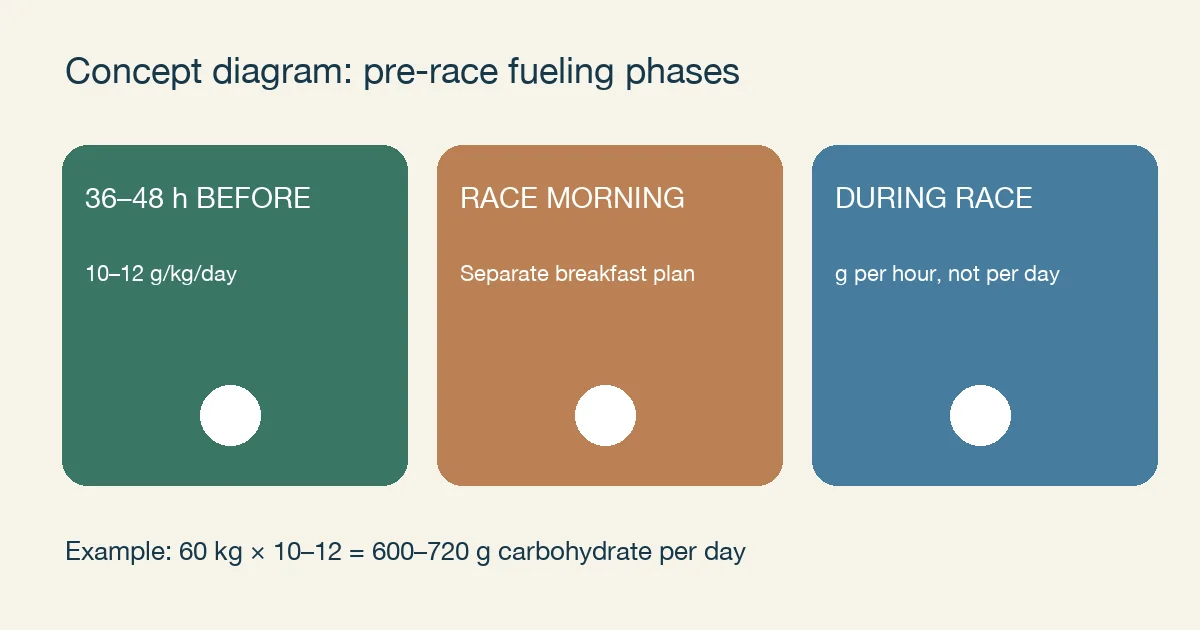
For a marathon or another race lasting more than about 90 minutes, carbohydrate loading means increasing carbohydrate intake during the final 36–48 hours while training is reduced. The commonly cited high-performance target is 10–12 grams of carbohydrate per kilogram of body mass per day. That is a daily amount before the race, not a gel target during it. It is demanding, so rehearse a realistic plan before race week instead of forcing unfamiliar food into the final two days.
The 2019 World Athletics review of nutrition for distance runners and race walkers describes this 36–48-hour, 10–12 g/kg/day approach for events such as the marathon. It discusses a contemporary loading method without the old glycogen-depletion phase. The numbers come from sports-nutrition research and expert synthesis, mainly for trained athletes; they are not a universal requirement for every recreational runner.
Calculate the daily amount, then check whether it is practical
Multiply your body mass in kilograms by 10 and by 12. A 60 kg runner gets a range of 600–720 g of carbohydrate per day during the loading window. The two-day arithmetic is 1,200–1,440 g in total, but the recommendation is expressed per day; eating the entire total on one day and very little on the other is not the same plan.
For perspective, a hypothetical day of three meals containing 130 g carbohydrate each and three snacks containing 70 g each totals 600 g (3 × 130 + 3 × 70). These are carbohydrate grams from nutrition labels or food tables, not the weight of the food. This example illustrates the size of the target; it is not a prescribed menu. If that volume causes stomach trouble or displaces foods you need, a sports dietitian can adapt the plan to your normal diet and race duration.
Why it is different from breakfast and gels
The point of the final-day strategy is to start a prolonged race with high muscle glycogen availability. The same World Athletics review distinguishes this from the pre-event meal and from fuel consumed while racing. Breakfast addresses the overnight fast and how your stomach feels near the start. Gels and sports drink are counted in grams per hour once the race begins. You cannot substitute one calculation for another.
For an example of the separate in-race calculation, see our guide to carbohydrate grams per hour. That article is in Japanese and uses gel and drink labels. Our race-morning breakfast example is also in Japanese; it addresses the meal closest to the start rather than the preceding two days.
A rehearsal checklist for the final two days
- Set the window. For a Sunday morning race, the final 36–48 hours generally include Friday and Saturday. Use the organizer’s local start time, especially if traveling across time zones.
- Count actual carbohydrate. Read the carbohydrate line on packaged food, then multiply by the number of portions. Do not use total package weight as carbohydrate weight.
- Spread intake across familiar meals and snacks. Choose foods and portions already tolerated in training. A sudden large increase in fiber, fat, or overall food volume can make the plan harder to follow.
- Keep the other race plans separate. Write down breakfast timing and in-race fuel in their own rows. Check drinking against conditions and personal needs; carbohydrate loading is no reason to drink excessively.
The evidence supports carbohydrate availability for prolonged endurance competition, but exact benefit varies with event duration, initial glycogen, training, and individual tolerance. The World Athletics paper is a review, not a trial showing that every 60 kg marathoner must eat 600–720 g. If you have diabetes, a gastrointestinal condition, or a medically prescribed diet, plan changes with a qualified clinician or sports dietitian.
Source checked 18 September 2026: World Athletics, Contemporary Nutrition Strategies to Optimize Performance in Distance Runners and Race Walkers (published 2019); Burke and colleagues, Carbohydrates for training and competition (published 2011).


コメント