
Short answer: plan a destination marathon around the direction of travel, not just the flight length. Eastward travel usually requires your body clock to move earlier; westward travel requires it to move later. Start shifting sleep toward destination time for a few days if practical, use light deliberately, and protect the final nights from avoidable sleep loss. A time-zone formula can guide planning, but it cannot tell you the exact day your body will be race-ready.
This worksheet is for adult runners crossing multiple time zones. It does not prescribe melatonin, sleeping pills or stimulants. If you take medication, have a sleep disorder, are pregnant, or have a condition affected by sleep loss or caffeine, make a plan with a qualified clinician.
East and west are different problems
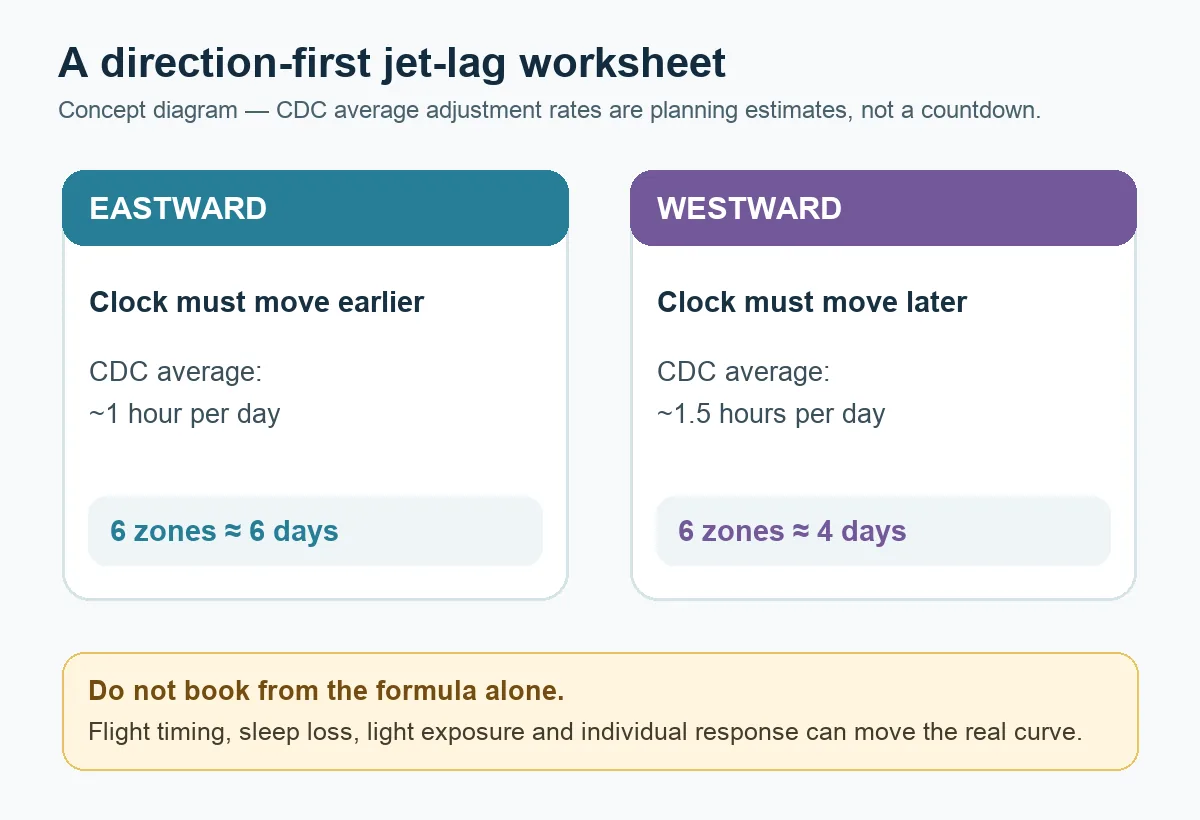
The CDC Yellow Book 2026 chapter on jet lag explains that eastward travellers need to advance the biological clock, while westward travellers need to delay it. It gives broad average adjustment rates of about one hour per day eastward and 1.5 hours per day westward. Those averages describe circadian adjustment; they are not guaranteed recovery times and are not marathon-specific.
For a six-time-zone trip, the arithmetic is:
- Eastward estimate:
6 ÷ 1 hour/day ≈ 6 days - Westward estimate:
6 ÷ 1.5 hours/day ≈ 4 days
Do not turn those numbers directly into a flight-booking rule. Departure time, missed sleep, exposure to light, trip duration and individual response all change the curve.
What athlete studies actually show
A 2022 systematic review of long-haul travel in elite athletes included 14 studies and 197 athletes across six sports. Athletes reported more jet lag and some physiological disturbance, but performance findings were inconclusive: only three of the ten studies that assessed performance found decrements in indirect performance markers. The review also noted small samples and limited ecologically valid performance measures.
A newer 2026 systematic narrative review included 89 studies across travel of one to 12 time zones. It found disturbances across sleep, fatigue, mood and some performance domains, with eastward travel generally linked to stronger circadian disruption. But 34% of the included studies were rated at high risk of bias, and the evidence pooled many sports and interventions. Neither review proves that a given runner will lose a specific number of minutes in a marathon.
A five-part race-week plan
1. Anchor everything to destination local time
Before departure, write the destination times for bedtime, waking, breakfast, bib pickup, transport and the start. During the flight, move meals, sleep and light exposure toward destination time when practical. This prevents a common error: following home time for one decision and local time for another.
2. Shift sleep gradually, without creating extra sleep debt
The CDC suggests moving sleep toward the destination for a few days before travel: earlier for eastward trips and later for westward trips. A one-hour shift is not useful if it costs two hours of total sleep. Protect sleep duration first, then make a modest shift you can actually sustain.
3. Treat light as a timed signal
Light can move the body clock in opposite directions depending on timing. Morning light generally promotes an earlier clock and evening light a later clock, but the useful window depends on your habitual sleep, route and number of time zones. Use the travel direction to identify the problem, then use a reputable jet-lag calculator or clinician for exact exposure and avoidance times. Randomly seeking bright light at every opportunity is not a precise plan.
4. Keep naps short and caffeine away from planned sleep
The CDC recommends avoiding long daytime naps after arrival; a short 20–30 minute nap can support alertness without making local bedtime harder. Its clinical chapter notes a caffeine half-life of roughly five hours and advises avoiding stimulants in the hours before bed. More caffeine is not a substitute for circadian adjustment, and a new caffeine or sleep-aid routine should not debut on race week.
5. Make the first run diagnostic, not heroic
An easy shakeout can tell you how alert, coordinated and comfortable you feel at the intended race time. It is not a hard workout to “force” adaptation. If you are unusually sleepy, dizzy, unwell or unsafe in traffic, stop and reassess. A missed tune-up is less costly than turning travel fatigue into injury or illness.
Build an arrival worksheet
| Question | Your answer | Why it matters |
|---|---|---|
| How many time zones? | ___ | Sets the scale of circadian change |
| Eastward or westward? | ___ | Advance versus delay |
| Local race start | ___ | Defines the performance window |
| Local sleep window | ___ | Anchors light, meals and caffeine |
| First easy run at race time | ___ | Checks alertness without adding heavy load |
| Fallback if sleep is poor | ___ | Prevents panic changes |
For race logistics, keep the circadian plan beside the organiser checklist. Our current guides for Berlin 2026 and Chicago 2026 separate local Expo and start deadlines from travel planning. For nutrition, calculate your food rather than changing everything after landing; the 36–48 hour carbohydrate-loading example is a separate worksheet.
What not to infer from the evidence
- There is no universal rule that one crossed time zone equals one lost race minute.
- The average east/west adjustment rates do not guarantee full adaptation on a fixed day.
- Elite-athlete travel studies cannot automatically be applied to every recreational marathoner.
- Melatonin timing is not interchangeable across directions; mistimed use can move the clock the wrong way.
- Hydration, compression socks or a shakeout cannot by themselves “cure” circadian misalignment.
Bottom line
Count time zones, identify east versus west, and anchor sleep, light, meals and the first easy run to destination time. Use the six-zone calculation only as a planning estimate, then leave room for individual response. The strongest practical move is often the least dramatic one: arrive with a written schedule and avoid adding sleep debt before the gun.
Fact check: 19 September 2026. Medical and travel guidance can change; check the linked primary and systematic sources before a future trip.

コメント