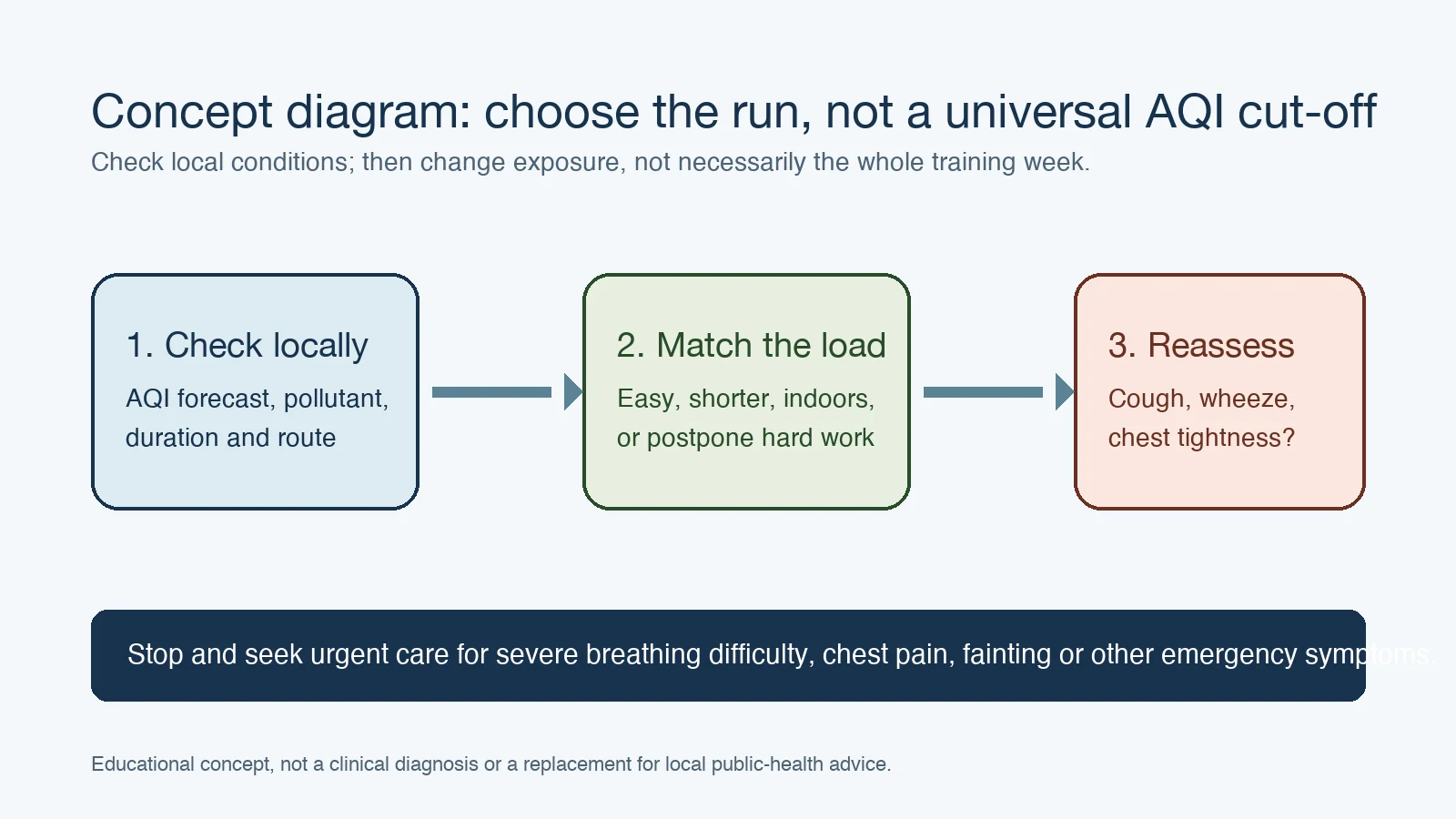
A run does not become automatically “safe” or “unsafe” at one universal AQI number. For runners, the more useful question is: what is in today’s local air, how long and how hard will I breathe it, and what can I change? When pollution or wildfire smoke is elevated, move the hard session, shorten it, choose a lower-exposure route, or go indoors. If you develop chest tightness, wheeze, unusual shortness of breath, dizziness or chest pain, stop—this is not a workout problem to push through.
Start with the local forecast—not a screenshot from another country
AQI is a public-health communication tool, but the underlying pollutant, averaging time and advice can differ by place. Check an official local service on the day of the run. In the United States, AirNow reports the AQI and pollutant; elsewhere, use the national or regional environmental-health authority. Do not treat a PM2.5 number, an ozone alert and a general AQI as interchangeable.
The World Health Organization’s 2021 air-quality guidelines are population health benchmarks, not a runner-specific green light. They are useful context for why PM2.5, ozone and other pollutants matter; they do not replace local, time-specific advice.
Why intensity and time matter more to runners
Hard running raises ventilation, so the dose is not captured by the AQI alone. The US EPA notes that the likelihood of being affected by particle pollution rises as outdoor activity becomes longer and more strenuous. That is why changing a 75-minute interval session to a 30-minute easy run is a different exposure decision, even on the same route.
Evidence is not equally strong for every pollutant. A 2022 systematic review of 53 randomized trials found high-certainty evidence that ozone exposure during moderate-to-vigorous activity adversely affected pulmonary function; evidence for several other pollutants and outcomes was insufficient or low-certainty (Hung, Nelson & Koehle, 2022). A 2025 endurance-exercise review likewise concluded that polluted environments can matter for cardiopulmonary health, while its included studies were heterogeneous (González-Rojas et al., 2025). Neither review establishes a personal performance penalty for every runner on every bad-air day.
A practical decision ladder
- Check the pollutant and forecast. Is the issue smoke/particles, ozone, traffic pollution, or an unknown local alert? Look at the time window for your planned run.
- Match the session to the exposure. When conditions are poor or trending worse, protect the quality session first: move intervals indoors, run easy for less time, or reschedule. The EPA specifically advises reducing outdoor time and activity level when wildfire smoke is high.
- Change the route only when it truly changes exposure. A park beside a major road is not necessarily low exposure. Avoid adding roadside warm-up kilometres just because the route looks scenic.
- Reassess during the run. Coughing, wheeze, pain on deep breathing or chest tightness are reasons to stop and get into cleaner air—not signals to test toughness.
For a key marathon workout, the least dramatic option is often the most useful: do the easy miles indoors or on a cleaner day, then preserve the hard work for conditions in which you can actually execute it. That is a better training decision than turning every alert into either a panic day off or an all-or-nothing test.
Who should use a lower threshold for changing plans?
People with asthma or other lung disease, cardiovascular disease, children/teens and older adults may receive more cautious advice from local authorities. If you have a diagnosed condition or a clinician-provided action plan, use that plan rather than this general framework. A respirator is not a simple running accessory: the EPA notes that it can make breathing harder and that people with heart or lung disease should seek clinical guidance before using one during high particle pollution.
Race week: separate heat, smoke and the warm-up
Air quality is one input, not a substitute for heat, hydration and start-line planning. On a warm race morning, pair the organiser’s communications with your heat strategy; our guide to pre-cooling for a hot marathon explains what the evidence can—and cannot—support. If the air is poor before a race, avoid adding a long outdoor warm-up merely from habit. The start-line warm-up decision guide can help you keep the movement goal while reducing unnecessary exposure.
Keep a one-line log
After any altered run, record: local pollutant/AQI, planned versus completed duration and intensity, route/indoor choice, and symptoms (if any). This is not a diagnostic test. It is a way to prevent two common errors: blaming every slow run on air quality, and repeating an exposure pattern that reliably causes symptoms.
Urgent-symptom note: Severe trouble breathing, chest pain, fainting, blue/grey lips or face, or symptoms that do not settle require urgent medical assessment. For recurrent exertional breathing symptoms, arrange non-urgent clinical evaluation before using a training workaround as the answer.



コメント