A supervised hip-and-core programme lowered lower-limb overuse injuries in one 24-week trial of novice recreational runners. That is useful evidence for treating strength as support for a gradual running plan—not as a universal “injury-proof” routine.

New runners are often offered two confident-sounding answers: “just stretch” or “do these exact drills.” A 2024 randomised controlled trial gives a more useful, narrower answer. In adult novice recreational runners, a physiotherapist-guided hip-and-core programme completed before runs outperformed static stretching for lower-limb overuse-injury outcomes. It does not establish that the same moves, unsupervised, prevent every runner’s injury.
What the trial actually tested
Leppänen and colleagues’ 2024 trial randomly assigned 325 novice recreational runners (245 women and 80 men) to a hip-and-core programme, an ankle-and-foot programme, or static stretching. All groups followed the same running programme; the exercise interventions were completed before runs and were supervised by a physiotherapist for 24 weeks.
Compared with static stretching, the hip-and-core group had a lower incidence of lower-extremity injury (hazard ratio 0.66; 95% CI 0.45 to 0.97). The authors also reported a 39% lower average weekly prevalence of overuse injury (prevalence rate ratio 0.61; 95% CI 0.39 to 0.96) and a 52% lower prevalence of substantial overuse injury (0.48; 0.27 to 0.90). The ankle-and-foot programme did not show the same overuse-injury advantage over static stretching.
Those numbers are associations within a specific programme and population. They are not a promise that “core work cuts your injury risk by 39%,” and they do not identify a single best exercise for every body, history, surface or weekly schedule.
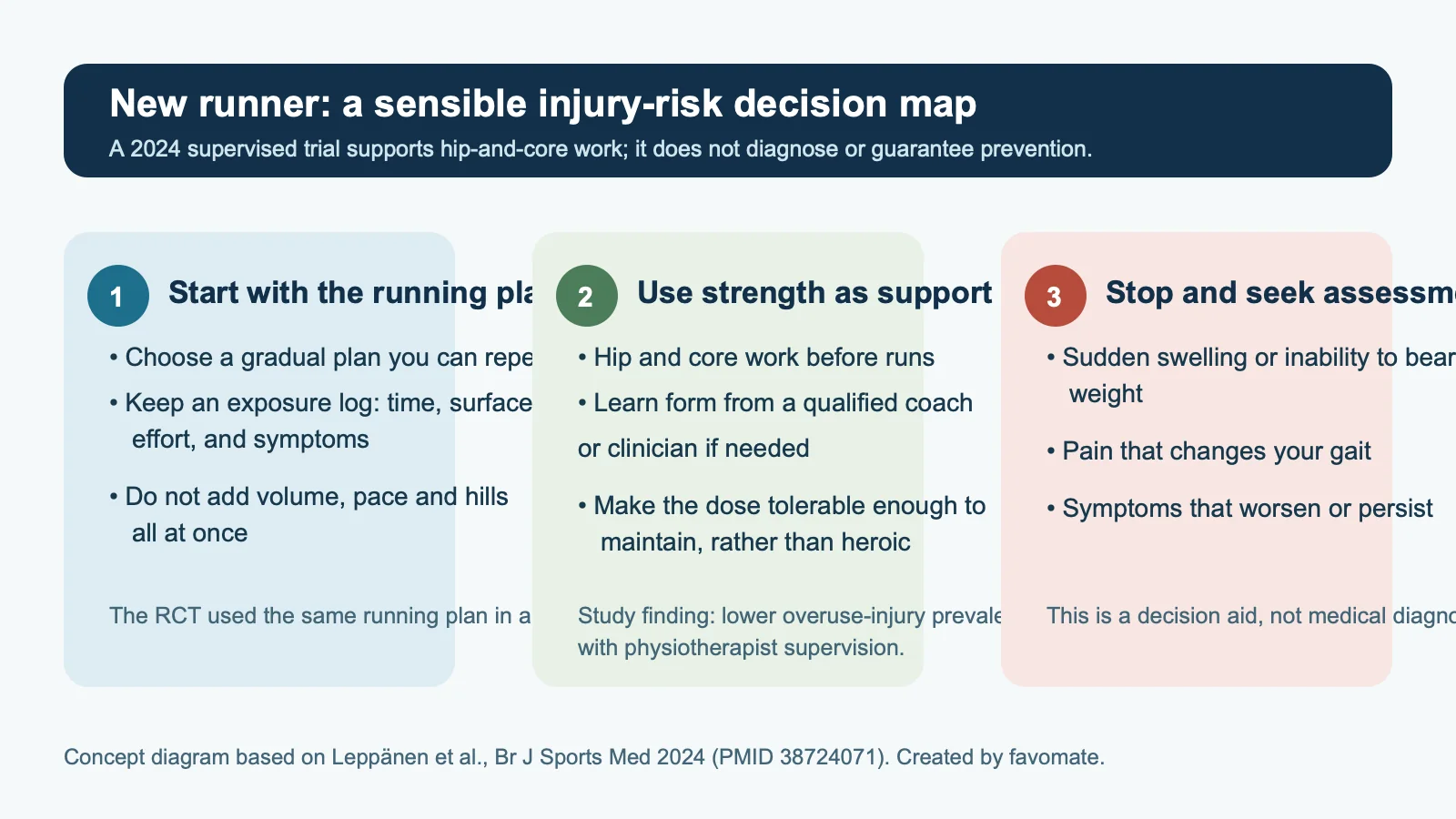
How to use this evidence without over-reading it
- Keep the running plan visible. The trial did not compare strength training with an uncontrolled increase in distance, hills and speed. Log time, effort, surface and symptoms so that a change has context.
- Use strength as a support layer. A qualified coach or clinician can help choose movements and a dose that do not make the next run worse. The evidence supports a supervised programme, not copying a social-media circuit.
- Change one major training variable at a time. If distance, intensity and hills all rise together, a later flare-up is difficult to interpret. This is a practical tracking rule, not a proven threshold.
- Escalate warning signs. Sudden swelling, inability to bear weight, pain that changes your gait, or symptoms that are worsening or persisting merit clinical assessment rather than another “prehab” session.
Why this is different from a general strength claim
Our runner strength-training guide discusses running economy and training frequency across broader runner populations. This article answers a narrower question: what has been tested for novice runners’ overuse-injury outcomes. The distinction matters because a programme that helps a beginner tolerate running may not be the programme or dosage that best serves an experienced marathoner.
A 2025 scoping review of runner-centred injury-risk reduction also concluded that support and supervision matter, while noting that many running-injury practices still need stronger long-term evidence. Read that as a reason to be specific about what has and has not been tested—not as a reason to wait for a perfect programme before starting gently.
A small, useful check before your next run
Write down: (1) what changed in the last seven days, (2) whether your walking or running form has changed because of pain, and (3) whether you can repeat the next planned session without compensating. If the answer to the last two is “no,” reducing or postponing the run and seeking appropriate advice is a better decision than trying to force a strength routine to solve a new problem.
Limits and sources
The main evidence was one supervised 24-week RCT in novice recreational runners; it cannot diagnose an injury, replace individual care or prove effects in every runner. The supporting review maps practices and preferences rather than proving a single protocol.
- Leppänen et al. Hip and core exercise programme prevents running-related overuse injuries in adult novice recreational runners (2024)
- Linton et al. Running-centred injury prevention support: a scoping review (2025)
- Nguyen et al. Strengthening-based running training in novice runners: randomised pilot study (2024)


コメント