
Can you train your stomach for marathon fuel? Probably—but the evidence supports repeated, race-specific practice more than any universal gel schedule. A 2023 systematic review found only eight eligible studies, using interventions that lasted 4–28 days. Some trials reported less gut discomfort or carbohydrate malabsorption; others were unclear. Treat gut training as a controlled rehearsal, not a promise that more carbohydrate will always feel better.
This guide turns that limited evidence into a practical experiment: repeat the fuel you intend to race with, record symptoms, change one variable at a time, and stop escalating once you can execute the plan you actually need. It was reviewed on 1 October 2026.
- What does “gut training” mean?
- Why you should not copy the 90 g/h lab protocol blindly
- First, calculate the plan you are actually practicing
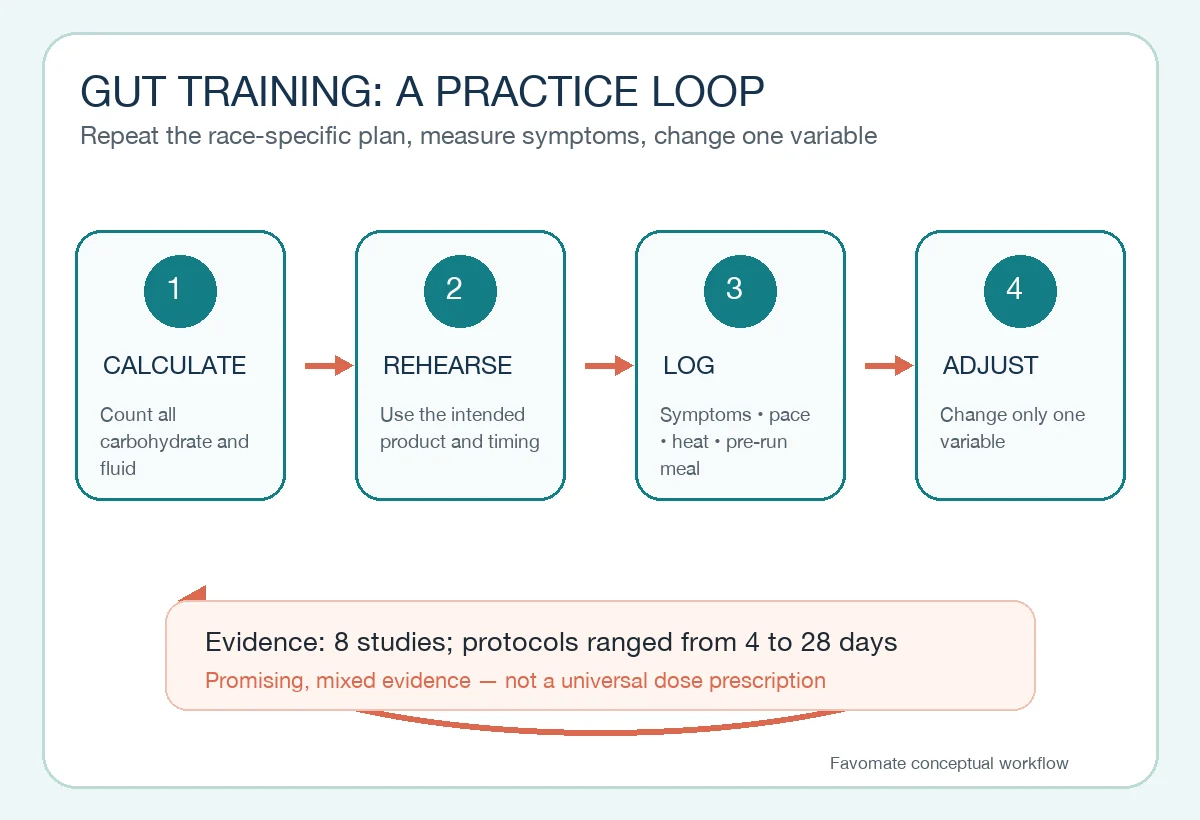
- A five-session rehearsal that changes one thing at a time
- Use a symptom log that can separate causes
- Four mistakes that make the experiment unreadable
- What should you do in race week?
- Bottom line
What does “gut training” mean?
In the research, gut training usually means repeatedly consuming carbohydrate or fluid before or during exercise so that the same challenge is better tolerated later. It is not a cleanse, a supplement protocol or a way to ignore persistent gastrointestinal disease.
The most useful evidence summary is a 2023 systematic review in Sports Medicine. The authors screened 304 records and included eight studies. Seven used carbohydrate-only interventions; one used carbohydrate plus protein. Protocols varied widely in sport, duration, food form and outcome measurement.
| Finding | What it supports | What it does not prove |
|---|---|---|
| Two studies reported an average 47% reduction in gut discomfort after a two-week carbohydrate-feeding protocol. | Repeated practice may improve tolerance for some athletes. | Every runner will improve by 47%, or that the same protocol fits every marathoner. |
| Two studies reported 45–54% less carbohydrate malabsorption; one found no significant change. | Absorption can adapt in some settings. | A single threshold or product guarantees absorption. |
| Two studies found significant symptom improvements; four produced unclear results. | The signal is promising. | The evidence is uniform or definitive. |
| No significant change was found in gastric emptying in two studies or intestinal injury/permeability markers in three. | Symptoms and physiology are not interchangeable. | Feeling better means every gut marker improved. |
Why you should not copy the 90 g/h lab protocol blindly
Two frequently cited running trials used a demanding challenge: 30 g of carbohydrate every 20 minutes, equal to 90 g/h. In one randomized study of 25 endurance runners, two weeks of carbohydrate practice reduced gastrointestinal symptoms and improved a one-hour distance test compared with placebo. The paper reported symptom reductions of 60% with gel discs and 63% with carbohydrate food. Read the 25-runner trial.
A separate blinded trial assigned 18 runners to 90 g/h of carbohydrate or placebo during daily one-hour runs for two weeks. The carbohydrate group later reported less discomfort, total symptoms, upper- and lower-gut symptoms and nausea, and had lower breath hydrogen. Read the 18-runner trial.
Those results do not make 90 g/h a starting prescription. The samples were small, the challenges were controlled, and the products, pace, heat, hydration and individual medical history may differ from yours. The goal is not to “win” gut training by reaching the study dose. The goal is to tolerate the amount and delivery pattern your race plan requires.
First, calculate the plan you are actually practicing
Use product labels and elapsed time. Do not count packets; count grams.
carbohydrate per hour = total carbohydrate consumed ÷ exercise time in hours
Example: three gels containing 25 g each during a 90-minute run provide 75 g over 1.5 hours, or 50 g/h. If a sports drink adds 30 g during the same run, the total becomes 105 g, or 70 g/h. Water, sports drink and gels must all be included in the log.
This arithmetic describes exposure; it does not decide the right target for you. The target depends on event duration, pace, prior intake, products, climate and medical context. If you need help setting it, work with a qualified sports dietitian. Pre-race loading is a different question; see our marathon carb-loading calculation guide.
A five-session rehearsal that changes one thing at a time
The schedule below is an editorial framework, not a trial-validated protocol. Use it across suitable long or marathon-specific sessions, not on every easy run.
- Baseline: use the product and timing you currently tolerate. Record grams, fluid, pace, temperature and symptoms.
- Repeat: keep the same plan. A single good or bad day can reflect heat, nerves, pace or meal timing rather than adaptation.
- Change one variable: if the plan falls short of your intended race exposure, change only dose, timing, product or fluid—not all four.
- Stress-test carefully: rehearse under a relevant pace or climate while leaving enough recovery time. Do not introduce an untested product and a harder pace together.
- Race rehearsal: use the final product, carrying method and timing. The success criterion is reliable execution, not the highest number.
Use a symptom log that can separate causes
After each test, score the worst symptom from 0 (none) to 10 (severe) and note when it began. Separate upper-gut symptoms—fullness, reflux, belching or nausea—from lower-gut symptoms such as cramping, urgency or diarrhoea. Also record pace or effort, heat, fluid volume, the meal before running and any medication.
A repeatable pattern is more informative than one difficult run. Symptoms that appear only when pace rises may not be solved by adding more fuel. Symptoms that follow one concentrated product but not the same carbohydrate split across time suggest a delivery problem. These are hypotheses to test, not diagnoses.
Four mistakes that make the experiment unreadable
- Changing everything: a new breakfast, gel, drink, pace and start time make it impossible to identify the driver.
- Counting only gels: sports drink and chews can materially change total carbohydrate and fluid.
- Testing only at easy effort: a plan tolerated during an easy jog may feel different at marathon pace—but the harder rehearsal should be introduced deliberately.
- Escalating despite worsening symptoms: gut training is not permission to push through severe or persistent symptoms. Recurrent vomiting, blood in stool, black stool, severe pain or symptoms outside exercise warrant medical evaluation.
What should you do in race week?
Do not use race week to chase a new hourly target. Use the plan that survived rehearsal, check the exact carbohydrate per serving, pack by time rather than vague distance, and keep a backup that you have already tolerated. If the organiser supplies fuel, verify the product, flavour, caffeine content and course location rather than assuming it matches your practice.
Bottom line
Gut training is plausible and supported by a small, mixed evidence base. The strongest practical takeaway is repetition with measurement: calculate the real exposure, rehearse the exact plan, log symptoms and adjust one variable. The studies justify testing—not overconfidence.


コメント