No—there is no evidence-based cadence number that every runner should chase. A modest cadence change can alter some loading measures, but the evidence for preventing future injuries or improving race performance is limited. If you want to experiment, do it at an easy pace, change only one thing, and use comfort and symptoms—not a watch’s “optimal” number—as the stop/go signal.

What “cadence” changes—and what it does not prove
Cadence is steps per minute. At the same running speed, raising it usually shortens step length. That observation is not a diagnosis of overstriding, and it does not mean a higher number is automatically safer.
A 2022 systematic review and meta-analysis of 37 studies found that increasing step rate changed several biomechanical measures, including lower step length and lower peak knee extensor moment. But only two studies addressed injury, and the authors judged the evidence insufficient to determine injury or performance effects conclusively. The review also found limited evidence that a higher preferred step rate can raise metabolic energy cost and perceived effort. Read the full review (PMID 36057913).
A separate 2022 review of 19 gait-retraining trials reached a similarly useful distinction: step-rate retraining increased step rate and reduced average vertical loading rate, but trials reporting pain were scarce and performance did not clearly change. Study details (PMID 35128941).
Use a small experiment, not a permanent form rewrite
A cadence change is most defensible as a short, reversible experiment—especially if a clinician has identified a reason to try it. It is not a substitute for assessing abrupt training changes, recovery, shoes, surface, or an injury that needs examination.
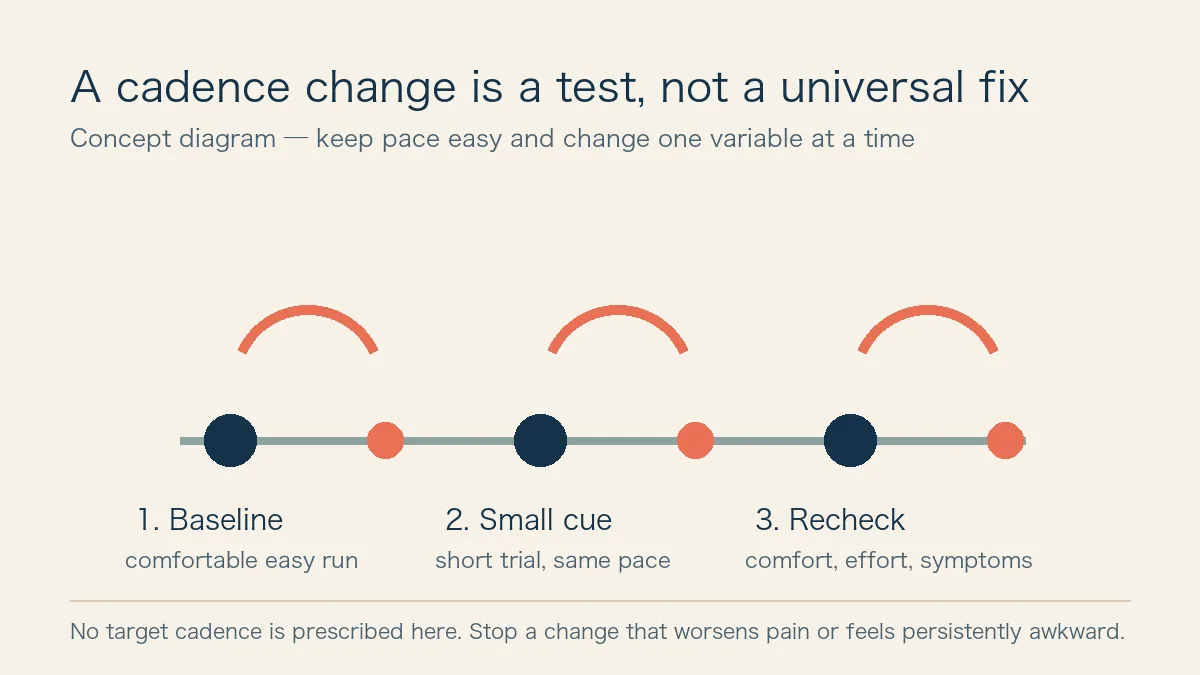
- Set a baseline. On a flat, easy run, note pace, cadence, perceived effort, and any symptoms. Do not compare cadence across very different speeds or hills.
- Use one gentle cue. For a few short easy intervals, try a slightly quicker, quieter rhythm without forcing foot strike or holding pace faster. Keep the rest of the session normal.
- Recheck the next day. Record whether the change felt awkward, pushed effort up, or changed a familiar symptom. If it does, return to your habitual rhythm.
- Do not stack changes. Avoid introducing a new shoe, hill block, speed session, and form cue in the same week; you lose the ability to tell what helped or aggravated you.
Why “just add 10%” is not a universal instruction
Many gait-retraining protocols study relative changes such as 5–10%, but those are intervention choices, not a race-day rule. The evidence base combines injured and uninjured runners, short laboratory exposures and longer retraining, and different feedback methods. The 2025 review of step-rate-based training found that both acute and multi-session protocols can raise step rate; it evaluated whether cadence changed, not whether every runner should retain the change indefinitely. Methods and results (PMID 41092785).
There is also a practical trade-off: at a fixed pace, a rhythm that feels artificially quick may increase effort. Race pace, terrain, fatigue, height, and individual mechanics all influence a natural cadence. A number on a wrist is a measurement, not a verdict.
When to stop self-experimenting
Do not push through sharp or escalating pain, swelling, a limp, numbness, night pain, or pain that changes normal walking. Seek a qualified clinician’s assessment rather than attempting to solve those signs with a metronome. For a broader look at training variables and injury risk, see Favomate’s novice-runner injury-prevention evidence guide; its key message also applies here: a study result is not an individual guarantee.
Bottom line
Cadence is a useful observation and sometimes a useful cue. Research supports that it can change mechanics, but it does not establish one ideal steps-per-minute target or guarantee fewer injuries. Keep any trial small, easy, and reversible; let comfort, symptoms, and the rest of your training context decide whether it belongs in your routine.
Sources
- Anderson LM, et al. 2022. Systematic review and meta-analysis of step-rate changes.
- Doyle E, et al. 2022. Gait-retraining systematic review and meta-analysis.
- 2025 step-rate gait-training systematic review. PubMed record.


コメント