An ultra hydration plan should be a set of checkpoints, not a fixed command to drink as much as possible. Start with the course, weather, aid-station spacing, and your own prior tolerance; then revise the plan during the race for thirst, heat, pace and symptoms. Overdrinking is a real risk, and one formula cannot safely fit every runner.

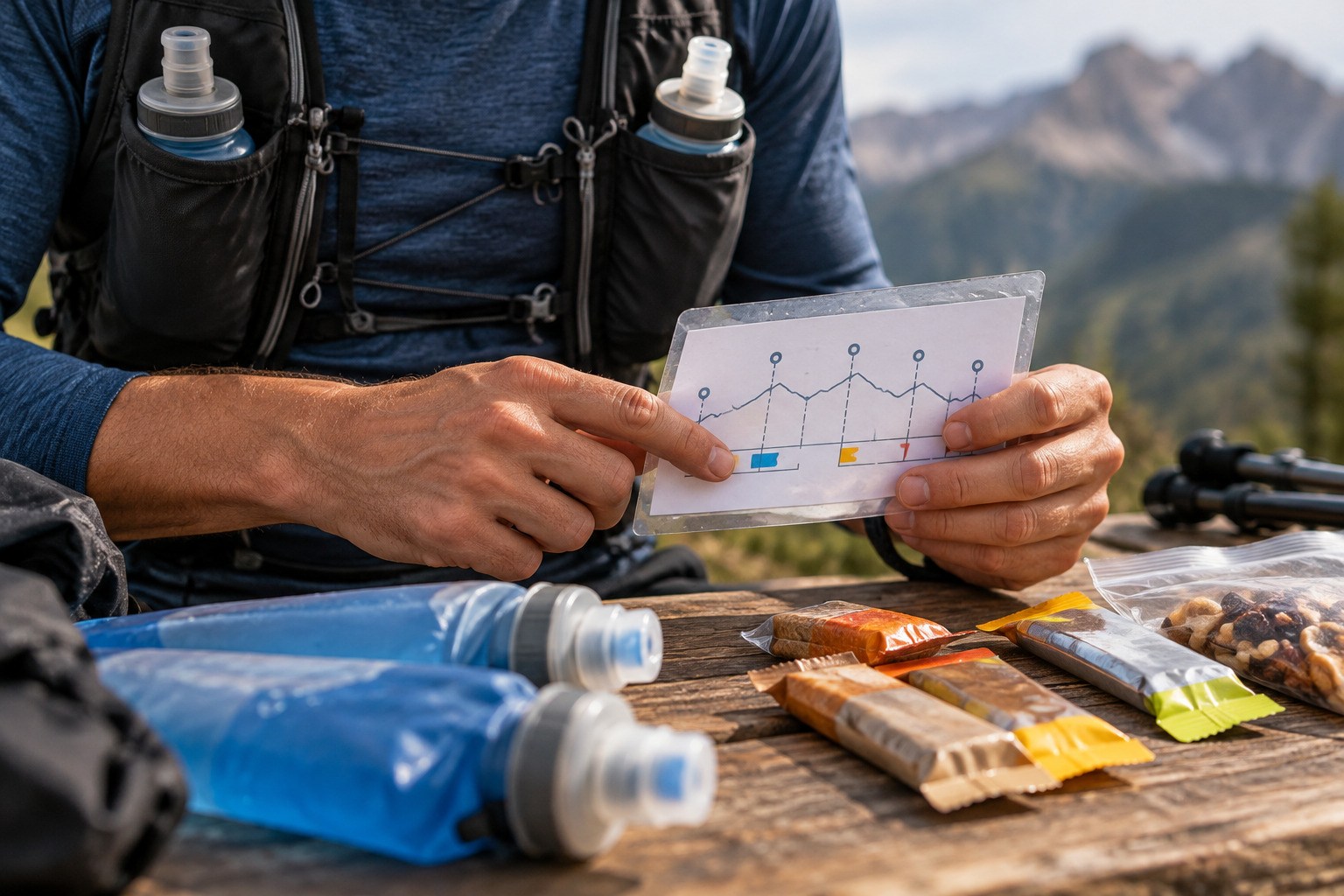
Build the plan from the course backward
- List each aid station, estimated time between them, and where reliable water is available.
- Write what you will leave with: fluid volume, carbohydrate source, electrolytes if you already use them, and a backup option.
- Use training long runs to test carrying access, not just stomach tolerance.
Use a range, not a prescription
Sports-medicine guidance emphasizes individualised drinking strategies and avoiding weight gain from excessive intake. Sweat rate varies with temperature, terrain, body size, pace and acclimation. Sodium losses vary too. A laboratory estimate can inform practice, but it does not replace attention to conditions and symptoms.
| Race moment | Useful check | Action |
|---|---|---|
| Leaving an aid station | Next water access and exposed climbs | Carry for the interval, not an imagined worst case |
| Hot climb | Thirst, pace, cooling options | Slow down; use shade/cooling where available |
| Nausea or bloating | Fluid, food and exertion together | Do not force more fluid; seek medical support if symptoms are serious |
Why “drink to a number” can fail
More fluid is not automatically safer. The International Society of Sports Nutrition position stand discusses exercise-associated hyponatremia risk in the context of excessive hypotonic fluid intake. This is not a self-diagnosis guide: confusion, severe headache, repeated vomiting, collapse, or worsening symptoms need immediate event medical attention.
Practise the logistics
On a long training run, rehearse opening flasks, mixing a familiar drink, and taking calories while moving. A 12 L vest can make room for weather layers and a larger carry, but capacity does not mean it must be filled; see our 12 L vest review framework for fitting considerations.
Bottom line
Plan the next aid station, test the setup, and adapt to the day. A written range and a stop-for-help rule are more useful than a universal hourly target.
Sources
ACSM position stand on exercise and fluid replacement · ISSN position stand on exercise-associated hyponatremia


コメント