
A marathon watch reading of 42.5–42.8 km does not, by itself, mean the course was long. The official 42.195 km is measured along the shortest permitted route with a calibrated bicycle. You rarely run that exact line, and your watch then estimates the path again from imperfect satellite positions. Those two differences can add up.
This guide separates the three distances that runners often mix together: the certified course, the line you actually ran and the distance your watch calculated.
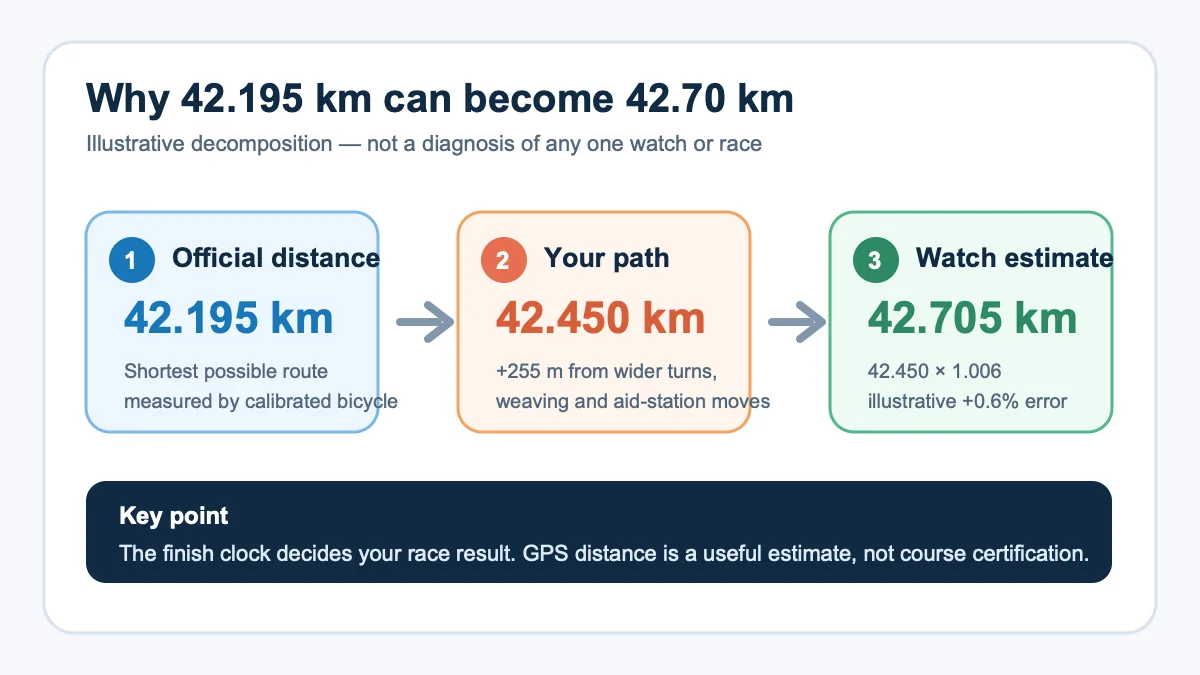
1. The certified course is the shortest possible route
World Athletics Technical Rule 55.3 says that a road course is measured along “the shortest possible route” available to an athlete. The approved method uses a calibrated bicycle, not a runner’s watch. The current rule also says the course must not be shorter than the official distance.
Course measurers follow the inside of bends and corners—normally about 30 cm from a kerb or other solid boundary—unless barriers restrict the race route. The World Athletics/AIMS Course Measurement Book shows how even different legal lines through one intersection can add several metres.
There is another easily misunderstood detail. World Athletics recommends a 0.1% short-course prevention factor when laying out the course. In the measurement calculation, each kilometre receives a measured length of 1001 m. For a marathon, 42.195 × 1.001 equals 42.237 km—about 42 m extra as protection against a future remeasurement finding the course short. The official race distance is still 42.195 km; this factor is a course-measurement safeguard, not a target distance that every athlete must record.
2. Your actual line is usually longer
Unless you are alone and can use the full road, you will not follow every tangent. Common sources of extra distance include:
- running wide around bends;
- weaving around other runners;
- moving to the edge of the road for water, toilets or spectators;
- following the centre of a wide road instead of the shortest legal line;
- crossing from one side of the road to the other repeatedly.
This is real distance, but it is not evidence that the certified route was wrong. In the diagram above, the athlete’s path is assumed to be 42.450 km—255 m longer than the nominal marathon.
3. The watch estimates that path with error
A watch samples satellite positions and joins those points into a track. Tall buildings, trees, underpasses, sharp turns, the side of the wrist and the device’s filtering algorithm can all change the result. Error does not always point in one direction.
In a validation study of eight positioning-enabled sport watches, researchers made repeated walking, running and cycling measurements in urban, forest and track settings. Across all environments, mean absolute percentage errors ranged from 3.2% to 6.1%; errors were generally worse for running and in urban or forest areas. That is a device-and-test study, not a forecast that your marathon watch will be wrong by the same percentage, but it shows why a single GPS total cannot certify a race course. See the open-access validation study.
A worked 42.70 km example
Suppose your actual path was 42.450 km and your watch overestimated it by 0.6%:
42.450 km × 1.006 = 42.7047 km
The watch rounds that to 42.70 km. In this illustrative case, about half a kilometre separates the watch total from 42.195 km, but it comes from two layers: 255 m of extra running and about 255 m of positive watch error. Without an independently surveyed track of your exact movement, you cannot cleanly split the total after the race.
How should you pace when GPS and course markers disagree?
Use the race clock and official course markers as the primary race reference. GPS remains useful for trend information, but auto-lap pace can drift when the watch reaches “1 km” before the course marker.
- Before the race: set a target time and write cumulative times for reliable checkpoints such as 5 km, 10 km, halfway, 30 km and 40 km.
- During the race: compare elapsed time at the course marker, not the watch’s accumulated distance alone.
- If your watch is ahead: do not speed up just to restore its average pace. Recalculate from official distance remaining.
- For execution: treat instant GPS pace as noisy, especially among buildings. Use lap averages, effort and course clocks together.
For example, a 3:30 marathon averages about 4:58.6 per kilometre. At the official 30 km marker, the even-pace cumulative target is about 2:29:18. If your watch says 30.3 km at that point, the official marker—not the watch’s extra 300 m—defines how far remains.
What a long GPS reading can and cannot tell you
| Observation | Reasonable interpretation | What it does not prove |
|---|---|---|
| Most runners record more than 42.195 km | Wide lines and shared environmental GPS error are plausible | That the certified course was long |
| Your map jumps across buildings or water | Satellite-position or filtering error is likely | Your exact true distance |
| Your watch reaches each kilometre early | Accumulated path/error is growing | That you should chase the watch pace |
| Official splits and finish time are consistent | Use them for race analysis | That every GPS point was accurate |
A simple post-race check
First compare your chip finish time and official splits with your plan. Then inspect the map for obvious straight-line jumps, repeated oscillation beside tall buildings or missing sections. Finally, compare where the watch laps occurred relative to official markers. A smooth-looking map is reassuring, but it still does not make consumer GPS the course-measurement authority.
If you are preparing for a crowded major race, use our Chicago runner guide to plan corrals, gear and fuel, and the destination-marathon jet-lag worksheet for travel timing.


コメント