Short answer: If you must run and lift on the same day, put the workout you most want to improve first. Evidence does not establish one universal order for runners; splitting the sessions when possible is the lower-conflict option. A strength-first order may favour lower-body dynamic strength in mixed training studies, while a run first is the more honest choice on a day whose key session is intervals, hills or a long run.
This is a planning guide, not a prescription. If pain, unusual fatigue, or a recent injury is changing your gait, replace the planned double with rest or seek individual clinical advice.

What the sequence research actually compares
“Concurrent training” means combining endurance and resistance work over a training block. It is not the same as proving that one 45-minute gym session and one particular run will work for every marathoner. In a systematic review and meta-analysis of 10 longer programmes in healthy adults, resistance followed by endurance produced a larger lower-body dynamic-strength change than the reverse sequence; the pooled difference was 6.91 percentage points (95% CI 1.96 to 11.87). The same review found no clear sequence difference for maximal aerobic capacity, hypertrophy or body fat. Read the review (PMID 28917030).
That result is useful, but narrow. It is not a race-performance trial in marathon runners, and it does not say that lifting before every run makes a runner faster. A 2025 semi-systematic review also concludes that the effect of order depends on timing, training status and the goal of the programme rather than offering a single winner. Read the 2025 review (PMID 41669271).
Use the day’s priority to choose the order
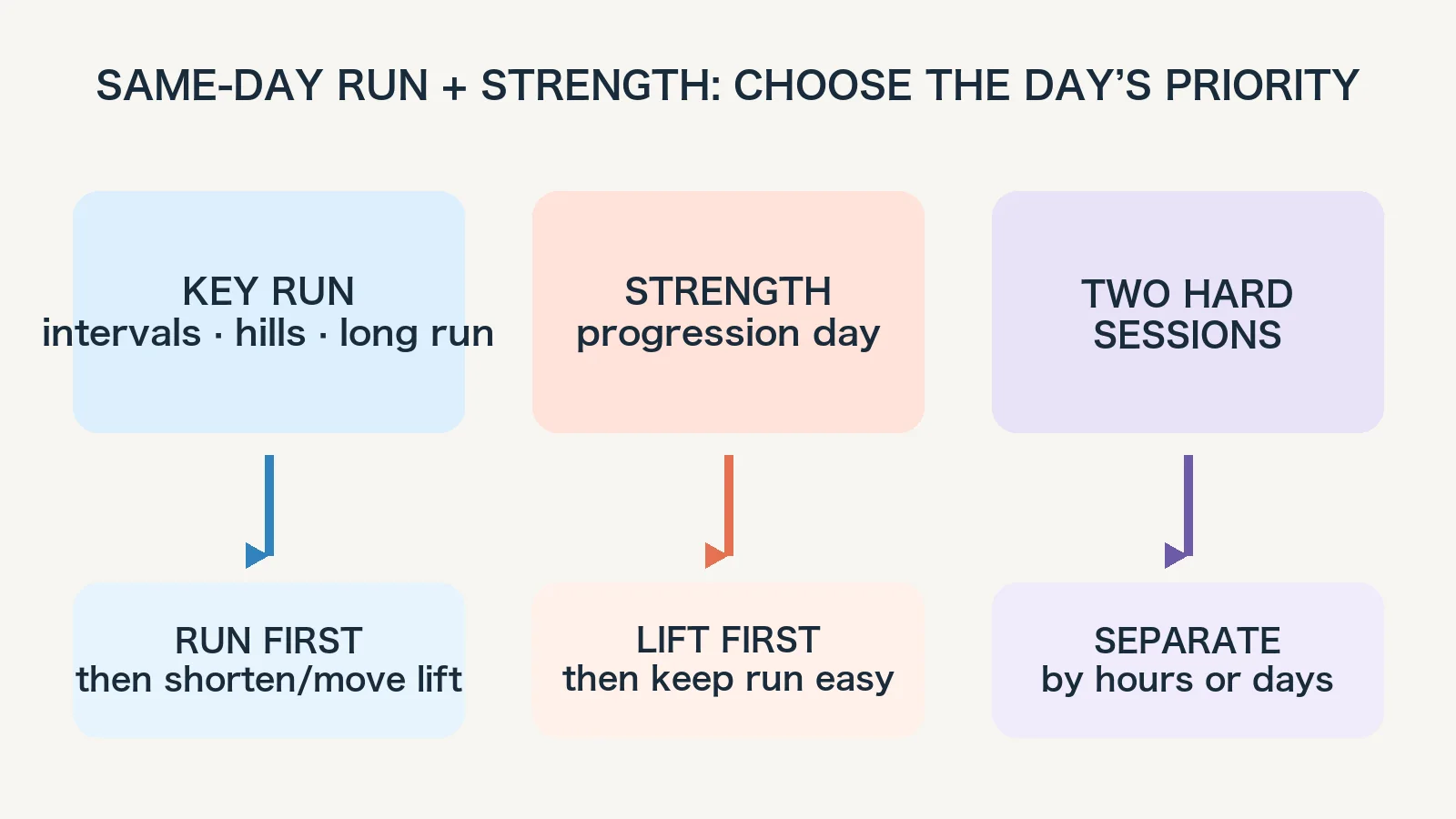
- Key run day: Run first. Protect the quality that the plan calls for—pace, hills, drills or duration—then make the strength session shorter, easier or move it.
- Strength-development day: Lift first, then make the run genuinely easy. This is the order most aligned with the dynamic-strength finding above, but it is not a mandate.
- Two hard sessions planned: Separate them by hours or use different days. Neither review supplies a magic recovery interval, so treat the next session’s quality and soreness as feedback rather than a rule.
- Easy/recovery run day: Either order can be reasonable if the run stays easy. Do not relabel a fatigued run as recovery just because it was scheduled that way.
A practical one-week example
Suppose your two important runs are Tuesday intervals and Sunday’s long run, and you want two resistance sessions. A defensible arrangement is a brief strength session after Tuesday’s completed workout and another strength-first/easy-run combination on Thursday or Friday—far enough from Sunday that it does not turn the long run into an unintended fatigue test. The exact days and loads depend on your background, sleep, work and injury history.
There is a reason to include strength work at all: an umbrella review of systematic reviews in trained middle- and long-distance athletes reported that strength training can improve running economy and endurance-performance determinants, while effects on VO₂max were not consistently significant. It also rated much of the underlying review evidence as low or critically low confidence. Read the umbrella review (PMID 40153564). That supports deliberate programming, not squeezing more hard work into every day.
Track the trade-off for two weeks
Keep the experiment small. Record (1) the order and approximate gap, (2) the planned versus completed quality of each session, and (3) your next-morning leg soreness and any pain that changes your stride. If strength-first repeatedly degrades a key run, reverse the order or separate the sessions. If run-first makes the strength work consistently too compromised for its purpose, move the lift to a day where it can come first.
For selecting the resistance work itself, see our guide to strength-training frequency and running economy. If you are new to lifting, keep progression conservative; a supervised novice-runner trial does not justify a universal injury-prevention promise, as explained in our evidence guide for new runners.
Bottom line
There is no research-backed universal “run first” or “lift first” rule. Protect the session that defines the day, use strength-first only when strength is genuinely the priority, and separate two demanding sessions when the next quality run matters. The best order is the one you can repeat without eroding the work you actually value.


コメント