
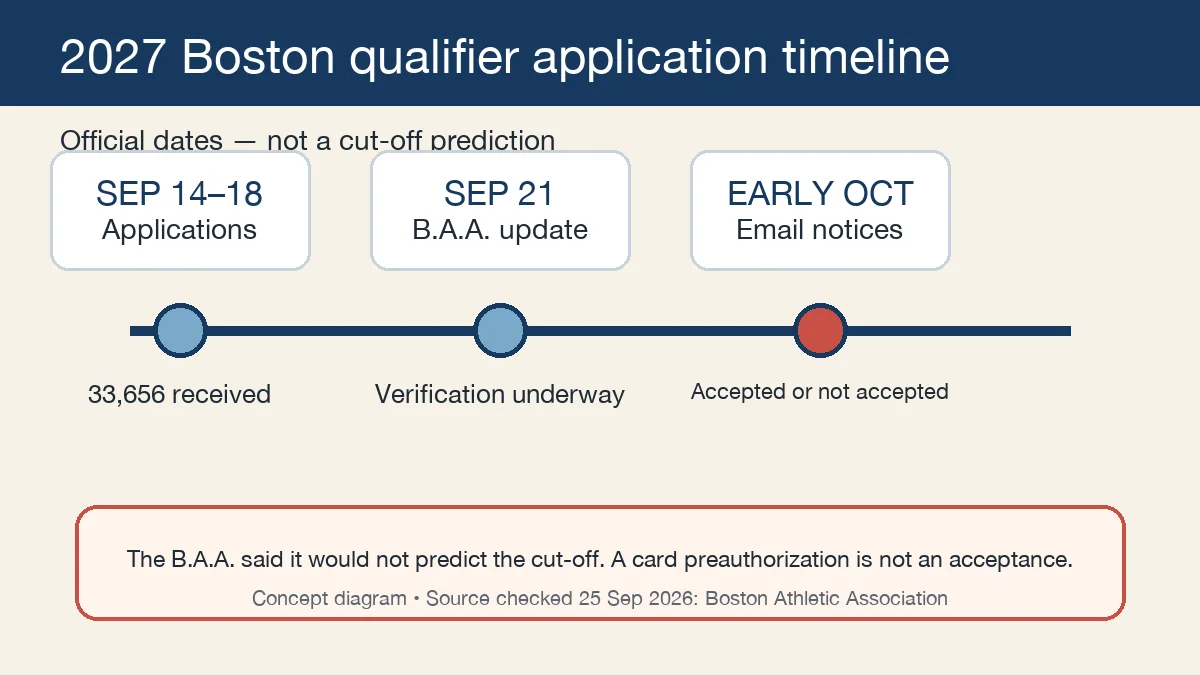
Short answer: 33,656 qualified runners applied for the 2027 Boston Marathon, but that number does not reveal the acceptance cut-off. The Boston Athletic Association said on 21 September that it would verify submissions and email acceptance or non-acceptance notices by early October. It also explicitly declined to predict the cut-off. Until that email arrives, a qualifying standard, an application receipt or a card preauthorization is not the same as an accepted entry.
- What the B.A.A. announced—and what it did not
- Use your verified buffer, not an internet cut-off guess
- Check whether a downhill index changes the time
- A card hold does not prove acceptance
- What happens if a qualifier misses the cut-off?
- A practical waiting checklist
- Why 2026 history is not a 2027 formula
- Bottom line
What the B.A.A. announced—and what it did not
The B.A.A.’s 21 September registration update says that 33,656 qualifier applications arrived during the 14–18 September registration window. Applicants came from 129 countries and all 50 US states. The race is scheduled for Monday, 19 April 2027.
The announcement also says that not every qualified applicant can be accepted because of field-size limits. Verification comes first; acceptance and non-acceptance emails are due by early October. The B.A.A. did not publish the number of places allocated to time qualifiers, so subtracting 33,656 from the event’s headline 30,000 field size is not a valid way to calculate a cut-off. The total field also includes entry routes other than qualifier applications.
Use your verified buffer, not an internet cut-off guess
A Boston “buffer” is the difference between the standard for your age and gender on race day and the time the B.A.A. accepts after verification. For example, a 35–39-year-old man has a 3:00:00 standard. An unadjusted 2:54:30 result would be 5:30 faster than that standard. This arithmetic describes the applicant’s position relative to the published standard; it does not predict acceptance.
The official qualification page says standards use official net, or chip, time and the runner’s age on 19 April 2027. It also states that registration was not first-come, first-served. When demand exceeds the space allocated to qualified runners, the fastest verified applicants within age and gender groups are accepted.
Check whether a downhill index changes the time
For 2027 registration, the B.A.A. introduced adjustments for qualifying courses with large net elevation drops:
- 1,500–2,999 ft (457.2–914.1 m) net drop: add 5:00 to the verified result.
- 3,000–5,999 ft (914.2–1,828.5 m) net drop: add 10:00.
- 6,000 ft (1,828.6 m) or more: the result is not eligible for Boston qualification.
That adjustment can materially change a buffer. For example, take a 35-year-old man with a 3:00:00 standard who ran 2:58:00 on a course dropping 2,500 ft. Applying the B.A.A.’s five-minute index produces 3:03:00, which is three minutes slower than the standard. This is a calculation example, not an acceptance prediction. Do not calculate from elevation gain, a course profile screenshot or total descending; the rule uses the net difference between start and finish, and the B.A.A. verifies the result.
A card hold does not prove acceptance
The registration update distinguishes payment authorization from an actual charge. Applicants may see a temporary preauthorization on their card statement. The B.A.A. says it charges the non-refundable, non-transferable and non-deferrable entry fee only after an application is verified and accepted. Treat the official email and status in Athletes’ Village as the decision—not a pending card line.
What happens if a qualifier misses the cut-off?
New for 2027, applicants whose verified qualifying time does not beat the eventual cut-off are automatically eligible for the Boston Qualifier Selection. The B.A.A. describes this as a random selection of approximately 1,000 qualifiers. “Approximately” matters: it is not a guaranteed second route, and the probability cannot be calculated until the eligible pool is known. Applicants do not need to make a separate cut-off prediction to enter this selection.
A practical waiting checklist
- Save the submitted result: record the race, official net time, age on 19 April 2027 and the standard used.
- Confirm course status: note whether the event is certified and whether the downhill index applies.
- Watch the right channels: check the email address used for Athletes’ Village, including spam folders, and use the official account rather than social-media predictions.
- Do not read a card hold as a result: the B.A.A. says only accepted applicants are charged the entry fee.
- Avoid non-refundable travel decisions: an application is not yet an entry. Check cancellation terms before booking anything while verification is open.
Why 2026 history is not a 2027 formula
The B.A.A. received 33,267 qualifier applications for the April 2026 race and 33,656 for 2027, an increase of 389 applications. That comparison is useful context, but it still cannot produce the 2027 cut-off. Verification outcomes, the qualifier allocation, age-and-gender distribution and the new downhill adjustments all affect the final pool. A historical cut-off is evidence of past demand, not a rule for this year.
Bottom line
As of 28 September 2026, the reliable answer is procedural: 33,656 applications are being verified, the B.A.A. will not forecast the cut-off, and notices are due by early October. Calculate your verified buffer carefully, account for any downhill index, and wait for the official decision. This article will need an update when the B.A.A. publishes acceptance results and the final cut-off.
Fact check: 28 September 2026. Primary sources: Boston Athletic Association registration update and qualification rules. Favomate is not affiliated with the B.A.A. The featured image is an AI-generated conceptual editorial illustration and does not depict a real event or athlete.


コメント